Starting with the human, not the software
A new ‘Prefer not to say’ title option led to two badly addressed emails. Why a five-minute change can touch far more than the screen it starts on.

A small choice on a form
Recently, I filled in an enquiry form on a company website. It asked for my title, and the drop-down list included ‘Prefer not to say’.
I chose it. Technically I’m Mrs Vaughan, but I divorced a good while ago and never went back to my maiden name. I’ve never warmed to Ms either. I was overthinking it so I picked the option that let me move on.
On reflection, the option was most likely added with non-binary customers in mind - people for whom a gendered title doesn’t fit. That’s a considerate change. What happened next shows how a considerate change can still go wrong.
What came back
Shortly afterwards I received two automated emails. The first opened like this:
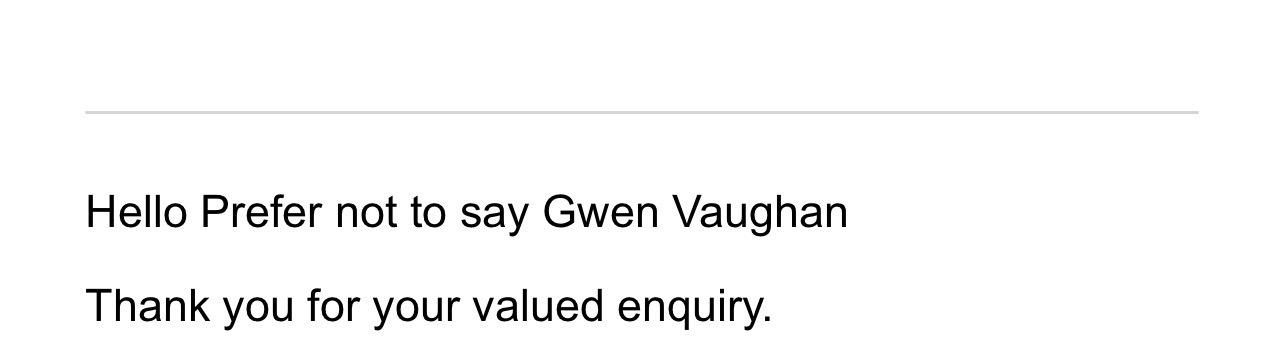
The second, from a different system, managed a slightly different version:

The option text had been dropped straight into the salutation. In one case it was also cut short and replaced my first name entirely.
It hasn’t put me off the company. But it isn’t a great start to a customer relationship, and the irony is hard to miss: an option added to make people feel respected ended up drawing attention to the very choice they made.
Why this happens
Adding an option to a drop-down looks like a five-minute job. The list is one field in one form, and the change on screen works perfectly.
The problem is everywhere else that field travels. A title is rarely just stored - it’s reused:
- in email templates and auto-responders
- in CRM records and sales follow-ups
- in letters, invoices and printed documents
- in third-party tools that receive the data, often with their own field limits
‘Prefer not to say’ isn’t a title. It’s a choice not to have one, so it needs different handling from every other option in the list. I imagine the product owner’s intention was simple: choose it, and the title drops out entirely, leaving ‘Dear Gwen Vaughan’. But each system downstream treated it like Mr or Dr and printed it as written. The second email adds another problem - the value was longer than that system expected, so it was cut short.
This is why a ‘five-minute change’ can cost more than people expect. Finding every place a field is used, agreeing how each should behave and testing them all takes time. It’s time well spent - otherwise your customers find the gaps for you.
None of this is unusual. It’s what happens when a change is treated as a UI tweak rather than a change to data that the whole customer journey depends on.
How we approach changes like this at Marino
What went wrong here wasn’t a single failure but a blend of three: research that didn’t get close enough to the people using the form, inclusive design that stopped at the drop-down, and testing that didn’t follow the data. At Marino, ‘Software Made Human’ means bringing technology closer to the people who use it - and that starts well before any code is written. We treat small changes with the same discipline as large ones, because small changes are where gaps like this tend to slip through.
- Discovery that starts with people. Before changing anything, we ask who the change is for and what they expect to happen. Here, that would have shown that choosing ‘Prefer not to say’ means ‘leave my title out’.
- Inclusive design that follows through. An inclusive option has to stay inclusive across the whole journey - the form, the emails, the letters and anything else the customer sees. A greeting that reads ‘Dear Prefer not’ works technically. It doesn’t work for the customer.
- Acceptance criteria on every change. Before any work starts, we agree what ‘done’ means - not just ‘the option appears in the list’, but ‘the option displays correctly in every place the title is used’.
- Tracing the data, not just the screen. Part of refining a change is asking where the data goes next. Emails, CRM, exports and integrations all go on the test list.
- Testing every touch point. Our QA team tests the full journey a customer experiences, including the automated messages that follow a form submission. Regression testing checks that nothing that previously worked has quietly broken.
In practice, the fix here could have been as simple as a rule: if no title is chosen, leave it out of the greeting. ‘Dear Gwen Vaughan’ or ‘Hello Gwen’ would have been fine. The hard part isn’t the fix - it’s knowing to look.
Small changes deserve full testing
Inclusive options are worth adding, and the intention behind this one was good. But inclusion doesn’t end at the form. If the experience that follows singles people out, the change hasn’t done its job.
Small slips like this also carry more weight than their size suggests. A broken feature gets reported and fixed. An awkward greeting gets screenshotted and shared, and people read it as proof of something bigger: that the organisation doesn’t really care about them. For the very customers an inclusive option was meant to welcome, that’s the opposite of the intended effect.
The next time a change looks too simple to need testing, it’s worth asking one question: where else does this show up?
Image: Marcin Wilkowski / Datified Relations / Licenced by CC-BY 4.0
Keep reading
More insights.
How we're using AI to bring design and development even closer together
Across our client work, we're connecting design and code with Storybook, Figma and AI. Here's why design systems, principles and people matter more than ever when AI is helping write the code.
 Garrett Sheridan ·
It's never just a patch: the human side of a critical security fix
When critical PHP vulnerabilities were announced on 21 October, we checked every system we support and contacted every client, affected or not. This is how we kept clients informed, which decisions we left to them, and why no fix skipped our usual checks.
Gwen Vaughan · 
Between the Wild West and the walled garden: how to build a trusted, secure agentic layer
AI agents will soon book appointments, switch energy, broadband and insurance for people. What CSOs, CTOs and CIOs need to settle first is identity, authority and trust. Marino Software has a track record in partnership with enterprise and organisations in regulated sectors. In this post, we look at a near future where people hand everyday admin to AI agents… and the security and trust decisions service providers need to make before they open the door.
 Ed Melvin ·